
While ReadSpeaker offers valuable learning supports, it is important for instructors to understand its pedagogical boundaries, technical constraints, and appropriate use cases.
These considerations help set realistic expectations for both instructors and students and reinforce sound instructional practice.
ReadSpeaker as a Supplementary Tool
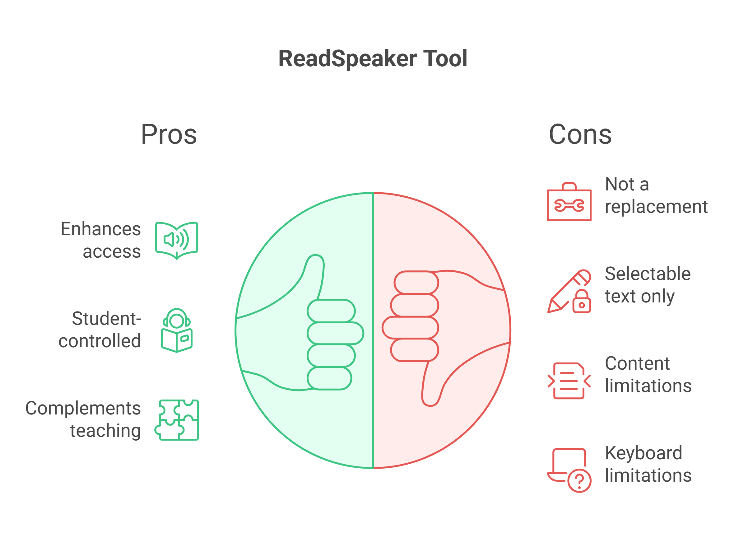
ReadSpeaker is designed to support access and comprehension, not to replace:
- Accessible content authoring
- Assistive technologies such as full screen readers
- Formal academic accommodations
- Instructional scaffolding or learning supports embedded in course design
It should be framed as an optional, student-controlled learning aid that complements inclusive teaching rather than functioning as a comprehensive accessibility solution.
Content and Format Limitations
- ReadSpeaker can only read selectable text
- Scanned PDFs, images of text, or poorly structured documents may not be readable
- Images must include meaningful text alternatives to be supported
- Poorly written or densely structured content remains difficult to process, regardless of audio support
- Some features are optimized for visual interaction and may be limited for keyboard-only users
Instructional implication:
Accessible, clearly structured course materials (e.g., using headings, HTML content, and meaningful text descriptions) are essential for ReadSpeaker to function effectively
Feature-Specific Limitations and Disclaimers
Dictionary Feature – Context and Accuracy Limitations
The Dictionary tool allows students to look up definitions of individual words directly within course content. While helpful, instructors should understand—and may wish to communicate—the following limitations:
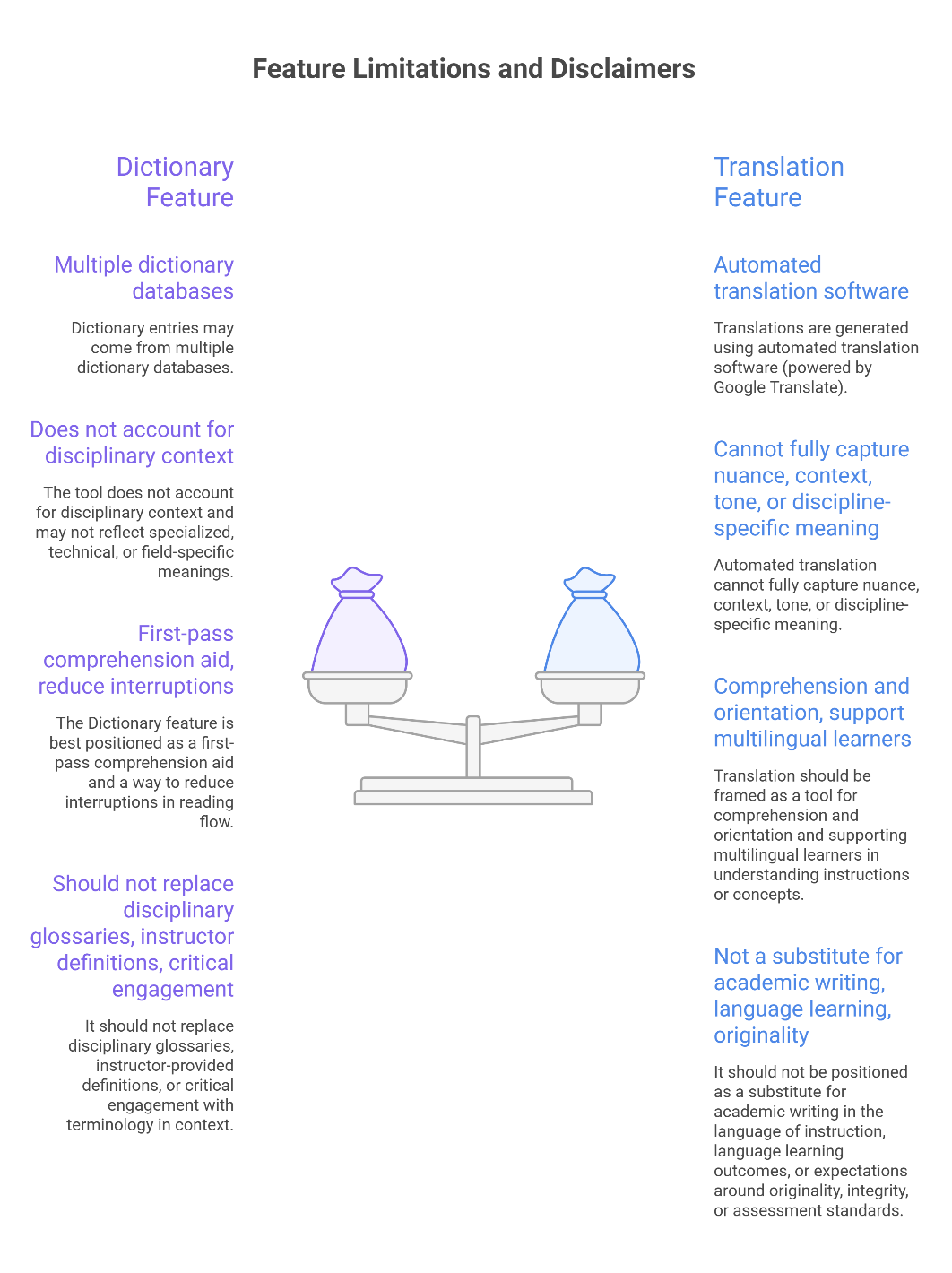
- Dictionary entries may come from multiple dictionary databases
- The tool:
- Does not account for disciplinary context
- May not reflect specialized, technical, or field-specific meanings
- When multiple words are selected, only the first word is looked up
Formal disclaimer (summarized for instructional context):
The Dictionary tool is provided “as is.”
- “Please note: The Dictionary tool uses different dictionary databases. No digital dictionary tool is perfect and the tool cannot take into account the context in which the word you are looking up appears. The Dictionary tool is provided as a service to users of this website, and is provided "as is." No warranty of any kind, either expressed or implied, is given as to the accuracy, reliability, or correctness.”
Pedagogical consideration:
- The Dictionary feature is best positioned as:
- A first-pass comprehension aid
- A way to reduce interruptions in reading flow
- It should not replace:
- Disciplinary glossaries
- Instructor-provided definitions
- Critical engagement with terminology in context
Translation Feature – Comprehension Support, Not Language Production
The Translation feature enables students to translate selected text into another language to support understanding. Translations are generated using automated translation software (powered by Google Translate).
Automated translation:
- Cannot fully capture nuance, context, tone, or discipline-specific meaning
- Is not intended to replace human translation or interpretation
- Translated text may contain inaccuracies, omissions, or awkward phrasing
Formal disclaimer (summarized for instructional context):
- Translations are provided “as is” for convenience. No warranty is given regarding accuracy, reliability, or correctness, and neither ReadSpeaker nor the institution is responsible for translation outcomes.
Pedagogical considerations:
Translation should be framed as a tool for:
- Comprehension and orientation
- Supporting multilingual learners in understanding instructions or concepts
It should not be positioned as a substitute for:
- Academic writing in the language of instruction
- Language learning outcomes
- Expectations around originality, integrity, or assessment standards
Assessment and Academic Integrity Considerations
ReadSpeaker can read instructions, questions, and prompts, which may:
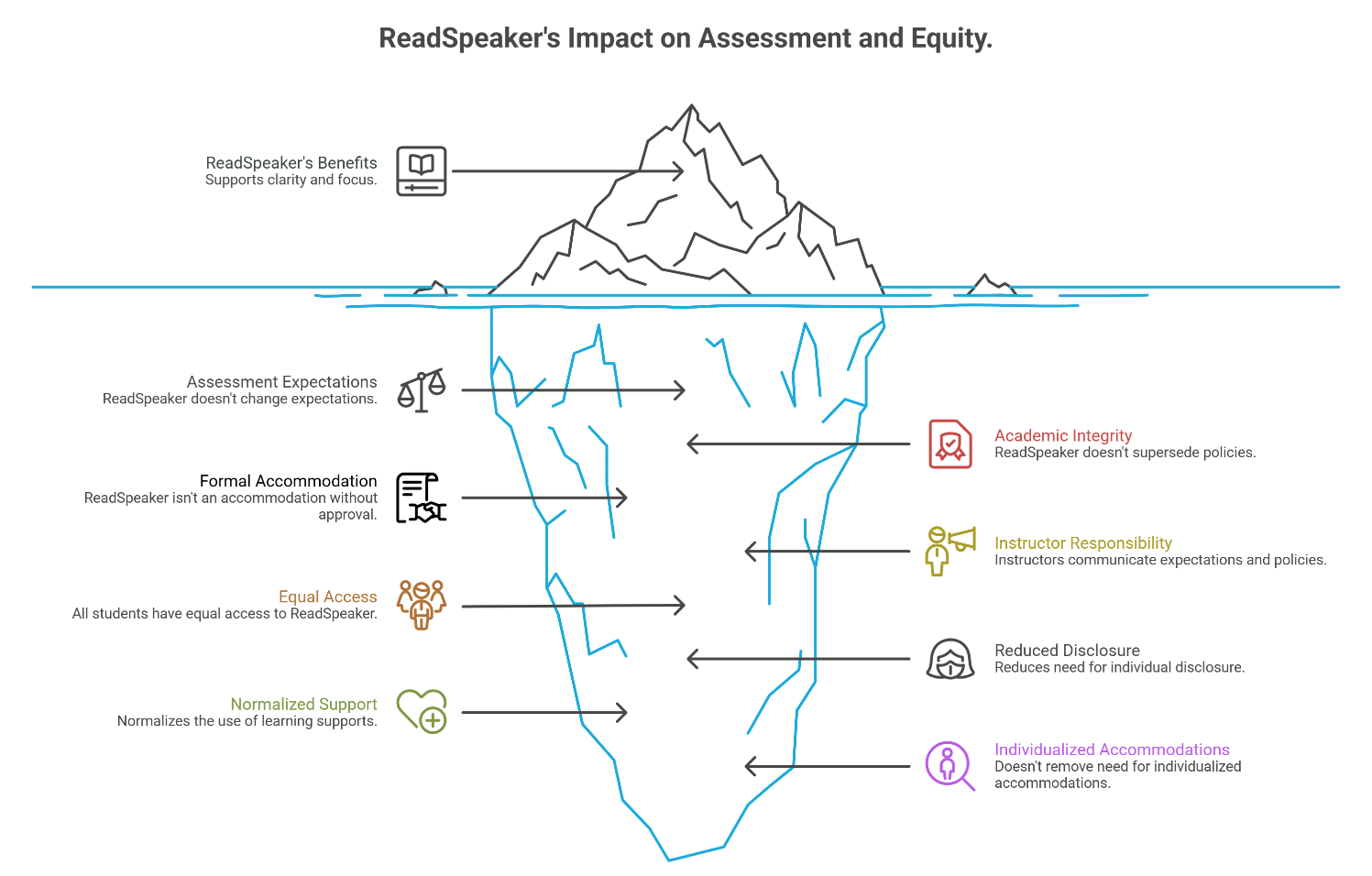
- Support clarity and reduce misinterpretation
- Help students focus on meaning rather than decoding
However, ReadSpeaker:
- Does not change assessment expectations
- Does not supersede academic integrity policies
- Does not constitute an accommodation unless formally approved through accessibility services
Instructional implication:
- Instructors remain responsible for clearly communicating assessment expectations, permitted tools, and academic integrity requirements.
Equity, Access, and Disclosure Considerations
As ReadSpeaker is enabled at the course level, all students have equal access to the same tools.
This:
- Reduces the need for individual disclosure
- Normalizes the use of learning supports
At the same time, it does not remove the need for individualized accommodations where required.
Key Takeaway for Instructors
ReadSpeaker provides meaningful support for comprehension, focus, and flexible engagement, but it is not:
- A guarantee of accessibility
- A replacement for inclusive course design
- An authoritative source for definitions or translations
Used transparently and thoughtfully, ReadSpeaker can enhance learning while reinforcing - not replacing - pedagogical responsibility and academic standards.

This work by Kwantlen Polytechnic University (KPU) is licensed under a Creative Commons Attribution-NonCommercial 4.0 International License.